


Concrete Vibration in Construction: Why Proper Compaction Matters
Discover how concrete vibration removes trapped air, reduces honeycombing, and supports better concrete compaction on construction sites.
Concrete Vibration in Construction is an important part of achieving properly compacted concrete during building work. When workers pour concrete into columns, beams, walls, and other structural elements, air can become trapped inside the mix. If workers do not compact the concrete properly, these air pockets may leave visible voids, honeycombing, and areas that need repair.
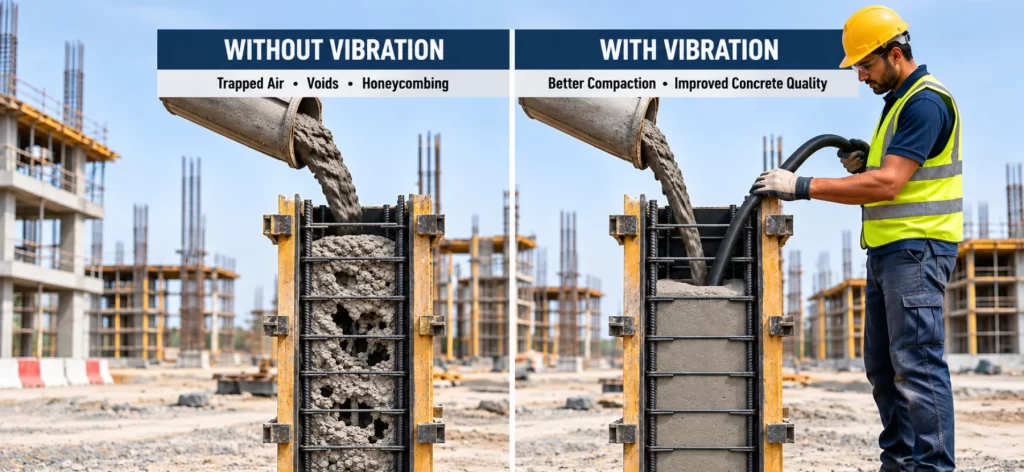
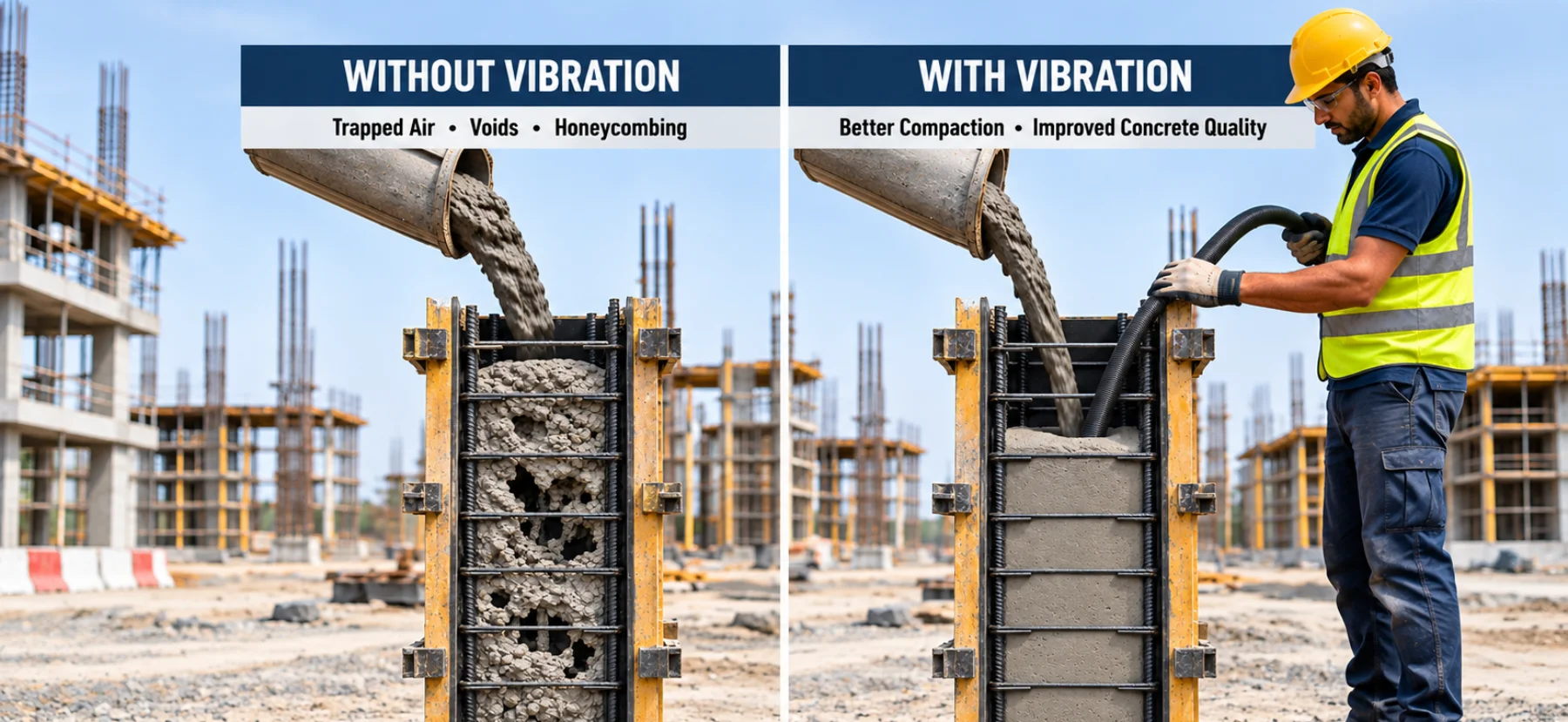
As illustrated in the comparison above, concrete placed without sufficient vibration can contain gaps and an uneven surface. With suitable vibration, workers can help the concrete settle around reinforcement and inside the formwork, producing a more uniform result.
For construction projects in Dubai and across the UAE, understanding concrete compaction is important when planning and carrying out civil and structural works.
Concrete vibration is a compaction method that uses mechanical equipment to remove trapped air from freshly placed concrete and help the mix settle into the formwork.
Fresh concrete contains a mixture of cement, water, fine aggregates, and coarse aggregates. During placement, air can become trapped between these materials, particularly around reinforcement bars and inside narrow sections of formwork.
A concrete vibrator produces rapid vibrations that temporarily reduce friction within the fresh mix. This allows the concrete to settle more effectively and fill the available spaces.
The purpose is not simply to make the concrete look smooth. Proper compaction helps produce a more consistent concrete element.
Concrete needs proper placement and compaction to achieve the intended result. Without sufficient compaction, trapped air can remain inside the concrete.
This may lead to:
Visible holes and surface voids.
Honeycombing around reinforcement.
Poor contact between concrete and reinforcement.
An uneven surface finish.
Localised areas that may require repair.
Concerns about the quality and durability of the finished concrete.
The extent of these problems depends on factors such as the concrete mix, reinforcement arrangement, formwork, placement method, and level of compaction.
When concrete receives insufficient compaction, trapped air may remain inside the poured element. This becomes particularly noticeable in congested reinforcement areas and narrow formwork sections.
Common signs include:
Honeycombing
Honeycombing describes areas where the concrete surface contains visible cavities and exposed aggregate. It can occur when the concrete does not properly fill the spaces within the formwork.
Surface voids
Small or large holes may appear on the finished concrete surface. Their presence can indicate inadequate compaction, although other factors may also contribute.
Poor consolidation around reinforcement
Concrete needs to flow around reinforcement bars and fill the spaces between them. Insufficient compaction can leave gaps in these areas.
Uneven concrete surfaces
Voids and poorly consolidated areas can affect the appearance and quality of the finished element.
If workers identify honeycombing or significant voids after removing the formwork, the affected area should be assessed before any repair begins. The appropriate corrective action depends on the location, depth, extent, and structural significance of the defect.
Suitable vibration helps fresh concrete settle and consolidate within the formwork.
When workers apply the correct method, they can achieve:
Better removal of entrapped air.
More consistent concrete around reinforcement.
Improved filling of corners and narrow sections.
Fewer compaction-related surface voids.
A more uniform finished surface.
Better consolidation of the placed concrete.
However, vibration must be controlled. Excessive vibration or incorrect equipment use can cause segregation, where the concrete constituents separate. Therefore, workers need to follow the approved method and concrete specifications.
Internal vibrators, also called poker vibrators, are commonly used for compacting concrete in structural elements.
The vibrating head enters the freshly placed concrete and transfers vibration directly into the mix.
They are often used for:
Columns.
Beams.
Reinforced concrete walls.
Foundations.
Slabs, where the method is suitable.
Workers should insert the vibrator carefully and distribute the vibration throughout the concrete. They should also avoid using the equipment to push concrete horizontally across the formwork.
External vibrators attach to the outside of the formwork. They transfer vibration through the formwork into the concrete.
This method may be suitable for certain precast elements, narrow sections, and applications where inserting an internal vibrator is difficult.
The formwork must be designed to accommodate the vibration and remain secure during the operation.
Surface vibrators work from the top of freshly placed concrete. They are used in suitable applications to compact and level concrete surfaces.
Depending on the equipment and project requirements, they may be used for certain slabs and flat concrete areas.
The correct equipment depends on the concrete element, thickness, reinforcement arrangement, and specified construction method.
Before concrete placement begins, inspect the formwork and reinforcement arrangement.
Check that:
Formwork is secure and properly supported.
Reinforcement is positioned according to the approved drawings.
Required concrete cover is maintained.
Concrete can flow into the available spaces.
Access is available for the selected vibration equipment.
Embedded items and service openings are correctly positioned.
Proper preparation helps workers place and compact concrete without unnecessary obstruction.
The concrete placement method should allow the mix to be compacted throughout the element.
For many applications, workers place concrete in successive layers rather than filling the entire formwork in one operation.
Layer thickness should follow the approved method and equipment capabilities. Each layer needs suitable compaction so that the concrete consolidates throughout the section.
When using an internal vibrator, workers should insert the vibrating head into the fresh concrete at appropriate intervals.
The vibrator should remain in position long enough to achieve proper consolidation without causing segregation.
Workers should also pay attention to:
Areas around reinforcement bars.
Corners of the formwork.
Narrow sections.
Connections between successive concrete layers.
Areas where concrete may struggle to flow.
The vibrator should be withdrawn carefully so that the concrete closes behind it.
Both insufficient and excessive vibration can affect the finished concrete.
Under-vibration
Insufficient vibration may leave trapped air, surface voids, and poorly consolidated areas.
Over-vibration
Excessive vibration can cause segregation, particularly when the concrete mix or application is unsuitable for the vibration method.
The correct duration and spacing depend on the equipment, concrete consistency, element dimensions, and approved method of placement.
Workers should follow the project specifications and guidance from the responsible technical team.
Honeycombing is one of the visible problems associated with poor concrete placement or compaction.
To reduce the risk:
Use a suitable concrete mix.
Confirm that reinforcement spacing allows concrete to pass through.
Check formwork for obstructions.
Place concrete using an appropriate sequence.
Compact each layer properly.
Use suitable vibration equipment.
If honeycombing appears after formwork removal, do not cover it immediately with mortar or another finishing material. First, arrange an assessment to establish its extent and whether it affects the structural element.
Closely spaced reinforcement can make concrete placement more difficult.
Before pouring, review the reinforcement layout, available access, concrete mix characteristics, and selected compaction equipment.
For congested reinforcement, the construction team may need to review the placement sequence and compaction approach to ensure that concrete reaches the required areas.
Incorrect equipment handling can create inconsistent results.
Workers should receive appropriate training and understand how to operate the selected vibrator. They should also inspect equipment before use and follow the approved site procedure.
Loose or poorly supported formwork can create problems during concrete placement and vibration.
Before pouring, inspect the formwork, joints, supports, and connections. The formwork should be suitable for the concrete pressure and construction operations involved.
Once the concrete has reached the stage when formwork can safely be removed, inspect the exposed surfaces.
Look for:
Honeycombing.
Visible voids.
Exposed reinforcement.
Cracks or other visible defects.
Uneven surfaces.
Damage around corners and edges.
Areas that may need further technical assessment.
Record any defects and refer them to the responsible engineer or technical team. Repairs should follow an approved method appropriate to the condition of the concrete.
Concrete quality control involves more than vibration. It also includes material checks, placement procedures, testing, curing, and inspection.
Depending on the project specifications, quality control may include:
Review of the approved concrete mix.
Delivery and fresh concrete checks.
Slump testing, where specified.
Concrete sampling and strength testing.
Inspection of formwork and reinforcement.
Monitoring concrete placement and compaction.
Appropriate curing procedures.
Inspection of completed concrete elements.
These activities help the project team assess whether the concrete work follows the specified requirements.
Concrete work in Dubai and the wider UAE requires careful planning around site conditions, concrete delivery, placement, and curing.
High temperatures can affect fresh concrete and the time available for handling and placing it. Therefore, construction teams should follow the approved concrete mix, placement procedure, and temperature-related requirements.
Good coordination is also important. Workers, equipment, concrete deliveries, reinforcement installation, and formwork preparation need to be organised before pouring begins.
A planned approach helps reduce interruptions during placement and supports consistent compaction.
Belresheed Building Contracting has been operating since 2004, providing construction and related building services in Dubai and Sharjah.
Our services include general contracting, residential and commercial construction, renovation, and civil and structural works, alongside HVAC, plumbing, and electromechanical installations.
For concrete-related construction activities, proper planning, coordination, and attention to project specifications are important parts of the wider construction process.
To discuss your building or construction requirements, contact Belresheed Building Contracting.
Discover how concrete vibration removes trapped air, reduces honeycombing, and supports better concrete compaction on construction sites.

A construction handover checklist helps UAE property owners inspect finishes, test building systems, record defects, and review important documents before accepting a completed project.

Planning a commercial renovation in Dubai? Learn how to plan your office or retail upgrade, understand renovation costs, manage approvals, and minimise disruption to your daily operations.